 ecbyts
Rare earths digital twin open for Law 15.506 RDI partnerships
About 4 min read
- Guide
- Audio
- Tour
Guided tour on a synthetic ionic clay model tracks cost, water and tailings per tonne of ROM while opening RDI partnerships under Brazil Law 15.506/2026.
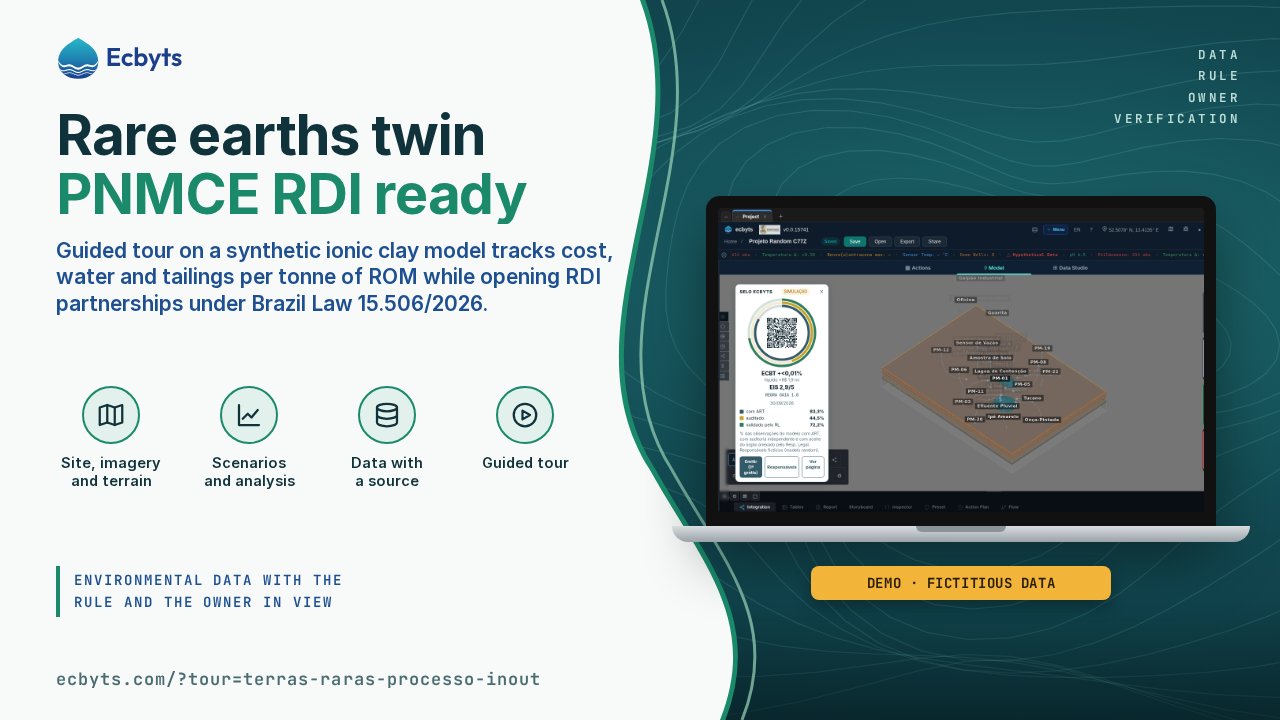
Rare earths projects, especially ionic adsorption clays, depend on coupled decisions across mining, scrubbing, physical upgrading, leaching, MREC refining and dry tailings stacking. ecbyts publishes an interactive public tour on a 100% synthetic flowsheet to demonstrate per-tonne mass balances and invite mining companies willing to accelerate product calibration through Research, Development and Innovation (RDI) budgets under Brazil Law 15.506/2026.
The gap between bench data and cost per tonne
In rare earth hydrometallurgy, isolated engineering and cost spreadsheets usually drift in three places. First, unit basis mismatches appear when beneficiation, leaching and refining normalize inputs differently, breaking consistency between cost per dry tonne of run-of-mine ore (ROM) and cost per kilogram of Mixed Rare Earth Carbonate (MREC).
Second, water and reagent feedbacks often sit outside the mass balance. Adjusting lixiviant salt dosage, water recycle ratio or filter cake moisture shifts energy demand, dry tailings tonnage and carbon intensity together.
Third, environmental modeling, process simulation and RDI funding remain disconnected. With Brazil's National Policy for Critical and Strategic Minerals (PNMCE, Law 15.506/2026 enacted on September 16, 2026), qualifying mining operators face statutory annual RDI allocation rules tied to critical mineral value chains.
How ecbyts solves it
The ecbyts process core represents all six stages of the synthetic ionic clay circuit inside one typed ledger (`processTwin`): Mine Extraction, Comminution and Scrubbing, Physical Beneficiation, Hydrometallurgy Leaching, MREC Refining and Tailings Dry Stack. Every extensive flow is computed on a dry mass basis and converted once per dry tonne of ROM, per tonne of product and per kilogram of MREC.
Inside the In-Out 3D panel on the canvas, declared scenarios (S0 through S4 plus Custom override) compare raising closed water recirculation from 86% to 92%, lowering regenerated MgSO4 dosage or switching to filtered dry stacking. Each calculated KPI carries explicit provenance pointing to its source revision, declared assumptions and uncertainty note.
On the co-development front, ecbyts is open to accelerating its digital twin, ionic-clay rheology solvers and domain AI models with mining companies ready to direct Law 15.506/2026 RDI capital into calibrated mine-to-MREC workflows.
In practice
Under Article 15 of Law 15.506/2026 (PNMCE), operators producing critical and strategic minerals allocate 0.3% of tax-net gross operating revenue annually to RDI during the first six years (alongside 0.2% to FGAM), rising to 0.5% after year six. Under Article 36 § 1, at least 50% of that RDI obligation is directed to external partnerships through the National Network for Critical and Strategic Minerals (RNMCE), which explicitly integrates startups and technology companies alongside research institutes.
Anyone can inspect the workflow immediately in the browser with zero sign-up and zero private deposit exposure. The synthetic public model demonstrates 20 USD/t dry ROM operating cost, 1.6 kg MREC output (at 60% TREO) per tonne of ROM, 0.9984 t dry tailings per tonne fed and live interactive switching to scenario S1 at 92% water recirculation.
What this feature is not
- All grades, reagents, costs, power figures and recoveries in this public tour are 100% synthetic and built solely for software demonstration.
- The public fixture does not disclose or represent any real orebody, mine operation, plant dataset or customer model.
- Running scenarios in the In-Out 3D panel does not replace laboratory metallurgical testwork, pilot trials, geotechnical studies or sign-off by a qualified engineer.
- References to Law 15.506/2026 explain publicly enacted statutory RDI rules for technical collaboration and do not constitute legal or tax advice.
How to practice
Launch the interactive rare earths digital twin tour in 6 steps (around 4 minutes) directly in your browser. Mining operators exploring RDI co-funding under Law 15.506/2026 can reach the founding engineering team at `founder@ecbyts.com` , visit ecbyts consulting or use ecbyts contact.