 ecbyts
Updated
Take the guardrail from standard requirement to digital twin
About 9 min read
- Guide
- Audio
- Tour
A guardrail modeled to NBR 9050 and NBR 9077 carries measurements, criteria and responsible parties, and can be reused, audited and shared. Fictitious data.
Modeling a guardrail to the standard takes decisions that do not show on the drawing sheet, and that work usually stays in a local folder, where another professional cannot find it and redoes the same measurements. In ecbyts, the component can carry the measurements, the checks, the edition of the standard and the person responsible, and enter a versioned library that other teams install. By the end of this article, you will know what the model has to prove, what changes when it enters the digital twin (the 3D and 4D replica of the facility, linked to the data) and what the Library and the Marketplace already allow today.
What the standard requires of handrails and guardrails
The first mistake in an accessibility retrofit is to treat guardrail and handrail as synonyms. They serve different functions:
- The handrail is the part that supports the hand, at a continuous height along the path, to give stability to anyone going up, going down or walking on a ramp.
- The guardrail is the protection against falls: the barrier at the edge of a landing, a stair, a mezzanine or a ramp.
A project can have both on the same stretch, and each answers to its own requirements. For the handrail, these are the requirements that come up most often in design:
- Installation on both sides of stairs and ramps, with a continuous handrail, without interruption at landings.
- Two heights: 0.92 m and 0.70 m from the finished floor, per ABNT NBR 9050:2020 (the Brazilian accessibility standard). ABNT NBR 9077:2001 (the Brazilian standard for emergency exits in buildings) allows the handrail between 0.80 m and 0.92 m and requires the double height on ramps, making it optional on stairs. Where the two standards apply together, the most restrictive reading prevails: 0.92 m and 0.70 m.
- Circular section with a diameter between 30 mm and 45 mm in NBR 9050 (NBR 9077 allows 30 mm to 50 mm), with a smooth surface, free of recesses and sharp edges.
- Minimum clearance of 40 mm from the wall or the guard to which the handrail is fixed, and a maximum width of 65 mm, so that the hand can close around the part.
- Extension of at least 0.30 m at the start and at the end of the flight, with the ends turned toward the wall or with an equivalent solution, with no loose ends.
For the guardrail, NBR 9077 requires a minimum height of 1.05 m, measured on the inside along landings, stairs and corridors, with non-combustible material and continuous protection.
A single measurement does not count: compliance lies in the combination. A handrail at 0.92 m with a diameter of 50 mm can meet NBR 9077 and still fail NBR 9050, which limits the grip to 45 mm. And a tall guardrail with an open gap between the balusters protects against falls and does not protect a child.
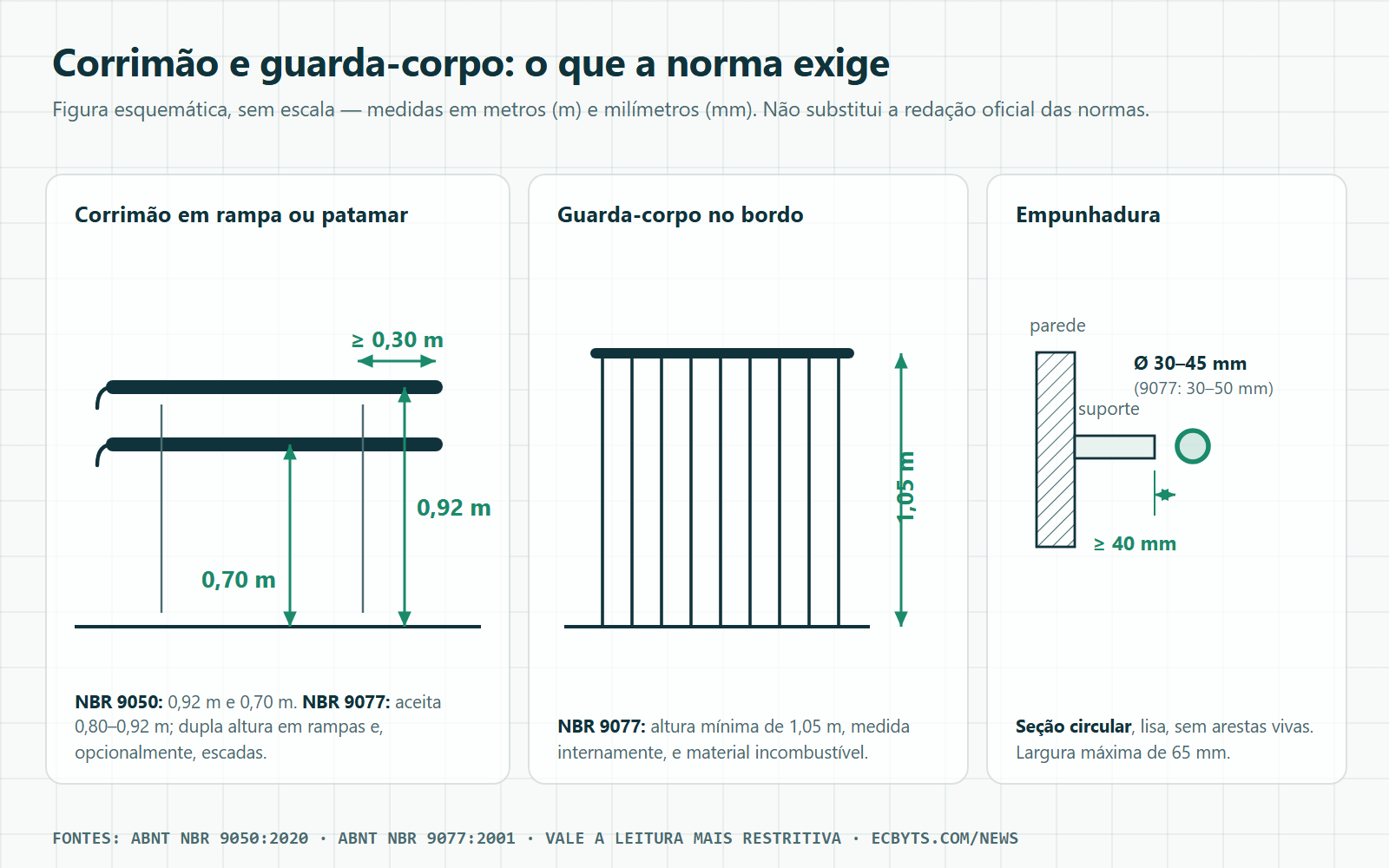
The figure is illustrative, has its labels in Portuguese and does not replace the official wording of the standards. It shows the central point of this article: each requirement can become a verifiable parameter inside the model, instead of a loose note on the drawing sheet.
How ecbyts solves it
A model that only draws the tube in the right position solves one project and does not solve the next. To become a reusable asset, the component has to carry more than geometry:
- Parameters with name and unit. Upper handrail height, lower handrail height, grip diameter, clearance from the wall, extension length and guardrail height. Without explicit parameters, every reuse is a new manual decision.
- Built-in checks. The component rejects combinations that violate the standard. This is where the library stops being a repository of drawings and becomes a quality mechanism.
- Standard metadata. Which edition was used, which clause was read, on what date. NBR 9050 is in its 2020 edition and NBR 9077 in its 2001 edition; an asset that does not record the edition ages without warning.
- Evidence and responsible party. Who modeled it, who reviewed it, which acceptance criterion was applied. Compliance without evidence is opinion.
- Version and history. The component changes when the standard changes or when the project requires a variation. Without a version, there is no way to know what is in use.
In the digital twin, the guardrail stops being an item on a drawing sheet and takes the exact place where it will be installed. This changes the question the team is able to ask:
- In space: the component appears in the real context of the stair, the landing, the walkway or the edge of the equipment, and the check no longer depends on the imagination of whoever reads the drawing.
- In time (4D): the installation can be followed across campaigns and construction phases, with the same component updated when the project changes.
- In the data: the guardrail can be linked to observations, nonconformities, technical reports and occupational health and safety indicators, instead of existing in isolation from the rest of the facility.
- In responsibility: the ecbyts responsibility layer shows who answers for each data point and what is still unsigned, the same reasoning as the ECBYTS Seal, applied to the rest of the model.
ecbyts organizes what can be shared in a versioned library, and access starts in the app itself. In the Libraries panel, the Standards Library item opens the library hub and the model marketplace. The planned categories include 3D Models, Family Modules, Model Presets, Domain Validators, Report Templates and Taxonomies, all marked as shareable and versionable.
What already exists today and what is still being released:
- Publishing and browsing libraries in the marketplace is real: the catalog by category exists, and published items can be installed by other users.
- The credits wallet exists and appears in the app's status bar, with statement, usage history and top-up.
- Paid courses are in the Training catalog, not in the libraries.
- Buying items inside the library marketplace is still switched off at this stage, until billing exists. If someone tries to buy, the app warns that the purchase is not yet available and charges nothing. Today the reliable path is to publish and share; the structure for authorship, price per item and credits is being prepared for when checkout is released.
In practice
Teaching example only, with fictitious data. A team models the Double stair handrail family with six parameters: upper handrail at 0.92 m, lower handrail at 0.70 m, 40 mm grip, 45 mm clearance from the wall, 0.30 m extension and a 1.10 m guardrail. The item record states NBR 9050:2020 and NBR 9077:2001, the acceptance criterion and who answers for the component. In another project, someone installs the family and changes the grip to 50 mm: the check the team built in rejects the combination, because NBR 9050 limits the grip to 45 mm, even though NBR 9077 allows up to 50 mm.
The path of a standards-based component to the library is short:
- model the parametric family with the measurements and the checks from the standard;
- record the edition of the standard, the acceptance criterion and the person responsible;
- publish it as a library item through the Publish your tool button or the Sell wizard in the Standards Library, providing the ECBT key;
- leave the item available for someone else to install, activate and reuse in their own model;
- track the usage and the version of what you published.
With these items, reusing is not copying a drawing: it is instantiating a component that already knows its limit, its evidence and the version it was built under.
What this feature is not
A digital twin does not create compliance by itself. It puts the question in the right place, with the evidence beside it; the one who answers technically is still the licensed professional, with an ART (Anotação de Responsabilidade Técnica, the Brazilian record of technical responsibility) and their own responsibility. A modeled standards-based guardrail:
- does not replace the ART and the technical responsibility of whoever signs the project;
- does not prove accessibility and does not replace a site visit and field inspection;
- does not replace the fire department review (in Brazil, the Corpo de Bombeiros), NBR 9077 or the applicable state technical instructions;
- does not freeze the standard: when the edition changes, the asset has to be reviewed and get a new version;
- does not turn the digital twin into an inspector: the model shows the rule and the evidence; the judgment remains human;
- does not guarantee correct installation: the modeled part and the installed part are different things, and the difference only shows up on site.
How to practice
Open the tour. The Do componente ao marketplace tour (From component to marketplace) shows the path from the component to the Standards Library; in English, this tour still appears in Portuguese, name and steps included. The Credits & Wallet tour shows where to find the $ECBT credit balance, which AI features and app services consume. Neither tour buys, downloads or changes anything in the account: they only show the way.
To start, choose the component you repeat the most. If you model the same guardrail in almost every project, it is the component with the highest return when turned into an asset. The same reasoning applies to items covered by the Brazilian occupational safety regulations (NRs), such as edge protection on construction sites (NR-18), machine guards (NR-12) and lifelines and anchorage (NR-35), or to any family that carries a safety rule. Parameterize the measurements, write the acceptance criterion, record the standard and the edition, and publish to the library.