 ecbyts
Updated
Environmental agencies in ecbyts, from audit trail to Validator
About 9 min read
- Guide
- Audio
- Tour
See what ecbyts already does for the environmental agency, what the Validator profile would add and what is missing for an institutional attestation to hold. Fictitious data.
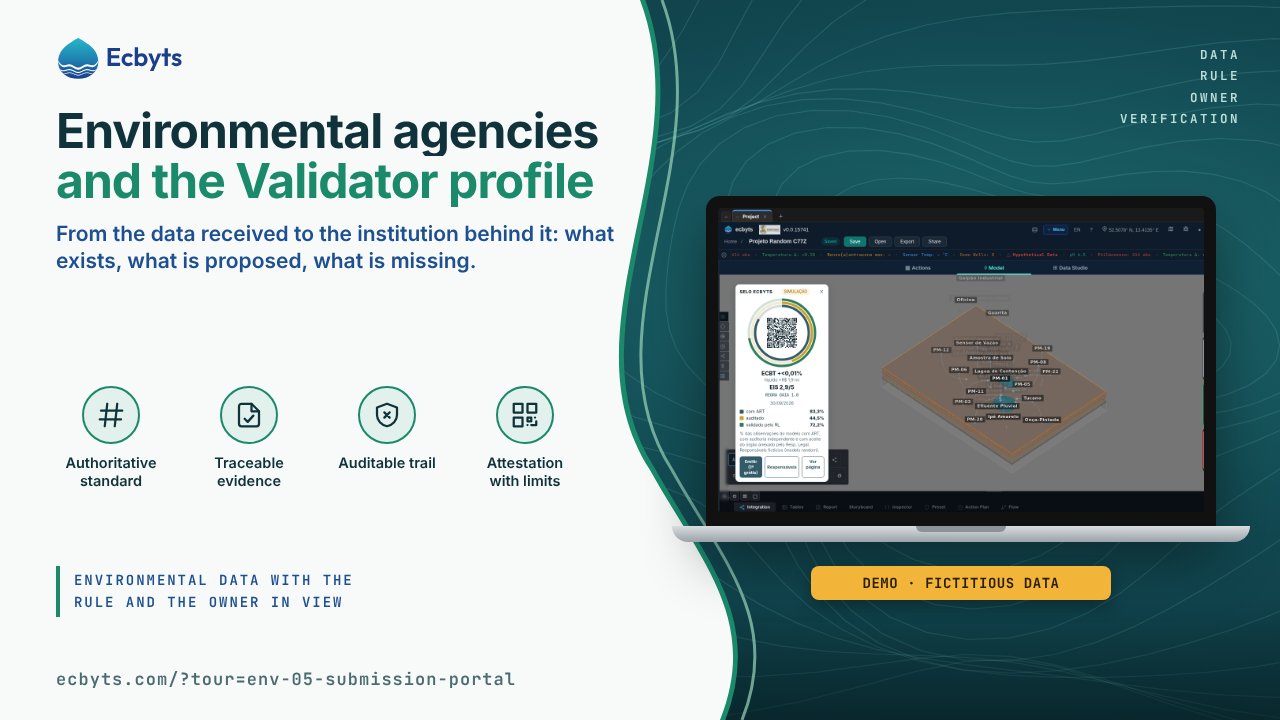
Receiving a case is not receiving a file: the environmental agency needs to know who sent it, on whose behalf, what changed between package versions, which standard it was analyzed against, who signed the opinion and what is still pending. ecbyts already covers the base of this chain, with a protocol number, checking, return of the error to the sender and an audit trail that no role can edit or delete. This article separates what already exists, what the Validator profile would add, a proposal not yet implemented, and what is missing for an institutional attestation to hold.
The governance of case requests
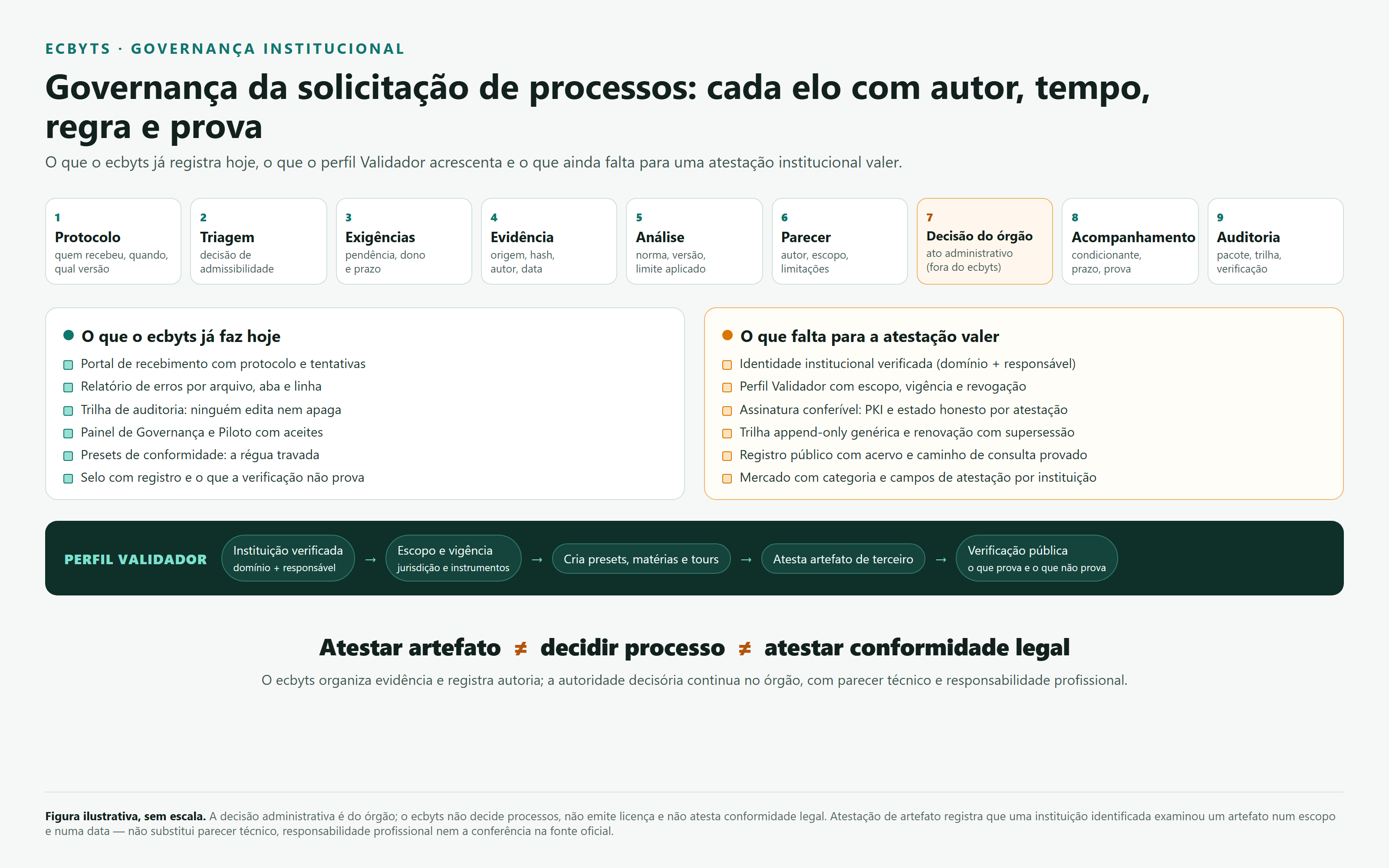
Governing case requests means answering a different question at each stage and keeping the answer on record.
- Protocol and screening: who received it, when, which version and which admissibility decision. Today: submission portal and audit trail.
- Requirements and pending items: owner, deadline and evidence of the reply. Today: sender report and alerts.
- Evidence: origin, hash, author, date and method. Today: import with checking, logical entities and trail.
- Technical analysis: standard, version, limit applied, calculation and source. Today: compliance presets, Legislation and Best Practices and report.
- Opinion: author, scope, limitations and segregation of duties. Today: Governance and Pilot and ECBYTS Seal.
- Decision: an administrative act, reasoned and signed. It stays outside ecbyts, because it is an act of the agency.
- Follow-up: condition, deadline and proof of compliance. Today: licenses, areas and alerts.
- Audit and transparency: exportable package, immutable trail and public verification. Today: audit trail and the ECBYTS Seal verification page.
The pieces exist on separate screens. What is missing is the institutional link: an identified institution at each end, with authorship, scope and proof in one continuous chain.
How ecbyts solves it
Anyone who works on data intake at an environmental agency will recognize these screens, all with a guided tour:
- EDD submission portal. The sender submits the package, receives a protocol number, sees the package rejected, resumes as attempt 2 and follows the progress. The previous attempt stays in the history.
- Error report for the sender. Each finding appears with file, sheet and row, the rule and the suggested fix, and the report goes back to the sender for correction and resubmission.
- Audit trail. Each line shows who did what on which object, with the previous and the new version. No role edits or deletes an entry.
- Roles per organization. The organization defines administrative roles and institutional relationships (owner team, consultancy, environmental agency, laboratory, client, auditor, community and other). In Governance and Pilot, it records the people in charge, collects acceptances and enables features only for itself.
- Areas and logical entities. The case can be tied to a polygon with a declared coordinate system and to versioned data contracts, without creating a new table for each profile.
- Alerts. Submission, error, review and deadline generate a notice, with a labeled channel and the option to turn it off by type.
The regulatory layer also has a base. In Legislation and Best Practices, the standard appears with the receipt of the official source; when verification was not done, the card says "Source requires review before citing". Compliance presets fix the model's yardstick, that is, the reference, prevention and intervention values of each parameter and matrix. The preset registry already stores authority, jurisdiction, legal basis, validity, revocation and replacement, plus an authority signature field, empty today by design, and a three-level trust seal (verified, unverified and unknown authority) that does not yet appear on any screen.
The ECBYTS Seal completes the base: the technical lead, the auditor and the legal representative attest a model with attached evidence, consent and a deadline. Public verification proves that the registered content has not changed since issuance. It does not prove that the numbers are true or confirm the identity of whoever accepted, and the verification page says so.
The Validator profile is the proposal for the next step and has not been implemented. ecbyts would verify the institutional email domain, with human review and a person named by the institution. The institution would receive a profile with a declared scope (jurisdiction, topics and regulatory instruments), validity and revocation. Only then could it create or attest, in the Standards Library, four types of artifact, each with author, scope, version, validity and proof:
- Legislation preset. The official yardstick of values by parameter, matrix and land use, with legal basis, version and validity. When the standard changed, the previous version would indicate that an update exists.
- Institutional article. A text signed by the institution on an understanding, a rule or a procedure, with date, scope, official source and what the article does not prove.
- Institutional tour. A guided walkthrough of an agency process, taught with fictitious data and with the limits visible.
- Attestation of a third-party artifact. The record that someone with a verified identity checked a preset, an article, a tour or a domain validator against a standard and a date, within that scope and that version.
Validating the institution is not validating the person or validating the data. They are three different verifications: whether the institution is who it says it is, whether the person has the competence and mandate for the act, and whether the data is the same as what was received. ecbyts already handles the second in part, with auditable professional credentials, and the third in the trail; the first is the one that is missing.
In practice
An example with fictitious data shows the part of the chain that already works. Consultancy A sends Environmental Agency B the monitoring package for Case 1 through the submission portal and receives a protocol number. Attempt 1 is rejected with three findings (a parameter code outside the list, a swapped unit and an empty sampling date), each with file, sheet and row in the sender report. The consultancy corrects and resubmits; attempt 2 is accepted, and both stay in the audit trail. The deadline of the condition generates an alert for the person in charge.
None of this depends on the Validator profile. What it would add is proof that whoever answers for Environmental Agency B is in fact the institution. None of these names or findings comes from a real case.
What this feature is not
Attesting an artifact is not deciding a case. ecbyts organizes evidence, records authorship and shows limits; the administrative decision remains the agency's, with the opinion of the qualified professional and the technical responsibility of each one. An artifact attestation does not turn ecbyts into an environmental authority and does not replace checking at the official source.
Today, the "environmental agency" relationship in an organization is a declared label: it organizes invitations, but it does not prove a link, does not raise permissions and does not authorize anyone to speak for the institution. Corporate sign-in exists only as a design (the email domain chooses the organization and the identity provider group chooses the role), is turned off and has not been validated against a real identity provider.
For an institutional attestation to hold, the following are still missing:
- Verified institutional identity. There is no flow to validate an institution's domain.
- Validator profile. There is no validator role or table. Without scope, validity and revocation, "validated institution" would be just a new stamp.
- Verifiable signature. The ECBYTS Seal has no signature field, third-party stamps accept a declared signature that is never checked and the preset trust seal is only structural. A managed public key is missing, with issuance, distribution and revocation.
- Identity of whoever accepts. Acceptance of the ECBYTS Seal does not check the identity of whoever accepts or the accreditation of the verifier, and the check with the professional council starts as pending. "Evidence accepted by the agency" today is a document attached by a user.
- Recalculated numbers. Server-side recalculation runs only as a shadow and does not block issuance.
- History of the generic attestation. The ECBYTS Seal records append-only events, but the generic attestation has no history, and the stamp of the model file can change without generating a new stamp.
- Public registry of stamps in use. The registry exists on the server and is append-only, but it was empty at the last measurement (09/17/2026), and the publication and lookup path has no proof of being active.
- Chained renewal. The stamp registry does not point to the previous stamp, and updating an attestation leaves no trace for whoever audits later.
- Complete life cycle. Suspension, restoration and change of scope do not exist in the stored model.
- Attestation catalog screen. The catalog applied in production has 17 schemas, among them the operating license, but no code reads it during use and there is no screen to consult it.
- Right categories in the Standards Library. There is no category for a legislation preset, article or tour, nor fields for verifying author, scope, validity, revocation or verification address. Publishing today is an act of a user, not of the institution.
- Preset proposal and curation. The preset registry only accepts writes from the server, and there is no path for the institution to propose, review and publish its own yardstick.
- Guard against self-declaration on every screen. The guard that downgrades a self-declaration exists and is tested, but is turned on only in the environmental profile.
The order of construction follows the order of this article: first the trail and the sharing that already work, then the verified institutional identity, then the artifacts with authorship and scope and, only then, the attestation with signature, immutable trail and public verification. Each stage is published in the News once there is a measurement, including when the result is "not yet".
How to practice
The tours below open in the app with fictitious data, in the order of the chain:
- EDD submission portal (4 min)
- Error report for the sender (3 min)
- Audit trail (3 min)
- Roles per organization (3 min)
- Areas and logical entities (3 min each)
- Alerts and notifications (3 min)
To see the tours in sequence, use the tours path and the article on data governance tours. For the model attestation that already exists, read the article on the ECBYTS Seal. Eight agency process tours (screening, chain of custody and quality control, inspection, licensing analysis, opinion and conditions, review and decision, audit package and institutional sharing) run in a training environment and are turned off in the public version; a pilot with fictitious data, without real personal data, is in preparation.