 ecbyts
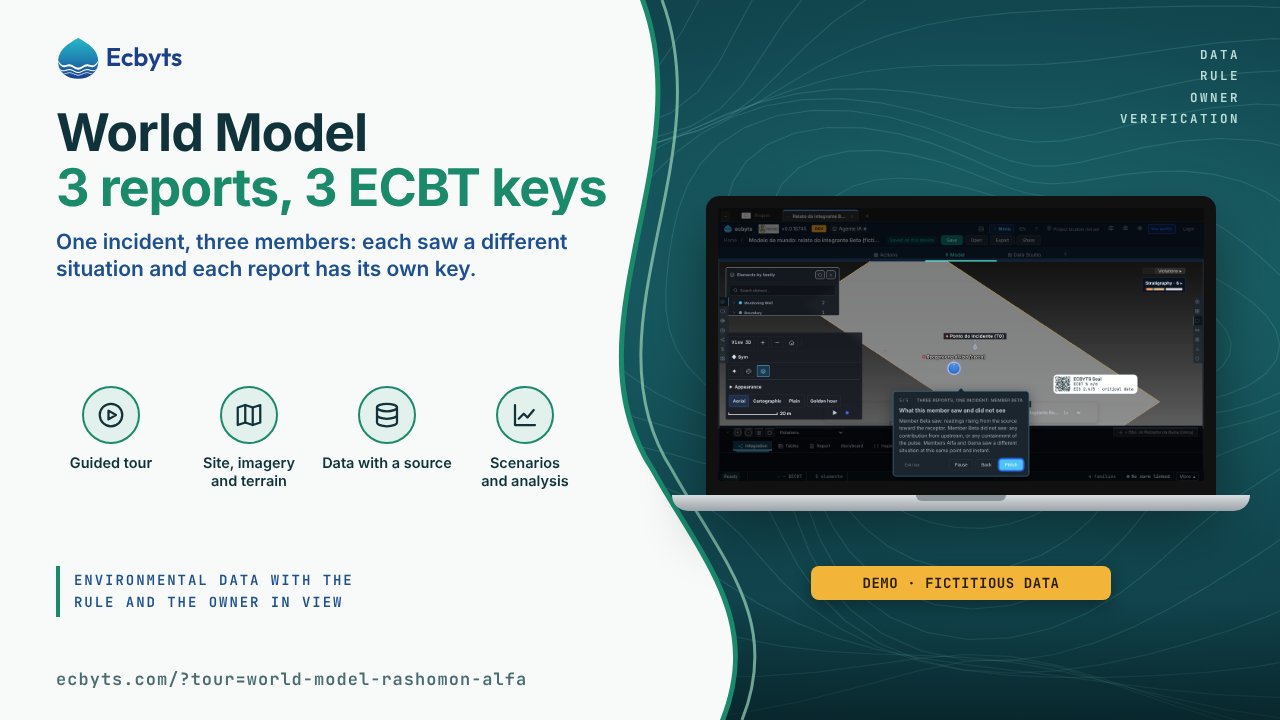
World Model: 3 conflicting reports on the same incident and 3 parallel ECBT keys
About 7 min read
- Guide
- Tour
In a real incident, the versions rarely agree. See why the ECBYTS protocol does not force an artificial consensus and how it turns 3 conflicting reports into 3 parallel scenarios with distinct cryptographic keys at the same point in space-time.
The Rashomon problem in engineering: when the same event produces three opposing truths
When a physical incident occurs — a sudden pressure change, the emergence of a chemical compound at a monitoring point, or a geotechnical anomaly — the physical fact happened at an exact coordinate (x, y, z) and at a defined instant (t).
However, in the minute following the event, three mutually incompatible reports emerge about what actually happened, what the origin of the problem is, and how large the risk is.
In traditional management systems and in summaries generated by conventional AI, the software tries to "resolve" the divergence in the worst possible way:
- Overwrite by hierarchy: only the version of whoever has administrator permission enters the database; the rest become lost emails.
- Artificial average: an attempt is made to create a diplomatic text that blends mutually exclusive technical premises, destroying the physical coherence of the model.
In a 4D World Model, divergence is not resolved by shouting hypotheses out of existence. If there are three conflicting interpretations of the same incident, the digital twin must sustain three scenario branches in parallel, anchored in the same physical event, but sealed with three different ECBT keys.
One incident, 3 competing scenarios, 3 ECBT keys
Imagine a single event recorded at the plant at instant T₀: an anomalous detection at the boundary of an operational area. From that same zero mark, three conflicting technical reports are submitted to the platform.
Scenario Alpha: hypothesis of a localized, contained anomaly
- The report: it argues that the event was a one-off operational pulse that has already been stemmed, assuming a homogeneous hydrogeological medium in which natural attenuation will keep the plume restricted to the internal perimeter.
- The impact on the World Model: the 4D simulation derived from this report projects a small radius of reach, no impact on external receptors, and a high score on the stability index.
- Why it generates ECBT key #1: this scenario has a specific set of boundary premises, selected PDPLU data, and an author responsible for the thesis. ECBT key #1 freezes exactly that technical bet.

What member Alfa saw / did not see: saw low readings near the source and nothing at the fence-line receptor in both campaigns; did not see any advance toward the fence line or an upstream source.
Download the ECBT key · Check the manifest · Open the tour
Scenario Beta: hypothesis of preferential flow and barrier breach
- The report: looking at the very same incident at T₀, a second report — from an independent risk team, an expert assessment, or an affected party — contests the homogeneity of the medium. It asserts that the recorded peak indicates a hydraulic connection through a fracture or a failure of containment, projecting rapid migration toward sensitive receptors.
- The impact on the World Model: with the same spatial starting point, the 4D propagation vector changes drastically. The uncertainty band (UNC-001) and the severity index spike.
- Why it generates ECBT key #2: it is not a revision of Scenario Alpha — it is an alternative, conflicting physical reality. Because the calculation yardstick, the transport hypotheses, and the selection of evidence change, the protocol generates its own deterministic hash: ECBT key #2.

What member Beta saw / did not see: saw a high reading at the source and a rising one downstream, with the fence-line receptor starting to register a value in the second campaign; did not see any contribution from upstream or containment of the pulse.
Download the ECBT key · Check the manifest · Open the tour
Scenario Gamma: hypothesis of an external source and upstream background
- The report: a third line of investigation argues that the chemical and temporal signature of the incident does not match the plant's current operation, attributing the anomaly to the arrival of a historical plume from upstream third parties or to cross-analytical interference.
- The impact on the World Model: the causal vector reverses in 4D space. The focus of responsibility moves away from the internal source and points to the outer edge of the modeled domain.
- Why it generates ECBT key #3: the boundary conditions and the attribution of origin are incompatible with Scenarios Alpha and Beta. ECBT key #3 is born, cryptographically isolating the third thesis.

What member Gama saw / did not see: saw the upstream point above the source in both campaigns, with the downstream points low and stable; did not see a plume leaving the source toward the receptor.
Download the ECBT key · Check the manifest · Open the tour
Comparison: 3 parallel branches at the same point in space-time
The three reports do not compete for space in the database: they occupy the same event and remain alive, each with its own key. That is what you see when the World Model places the scenarios side by side:
- Space-time anchor: all three start from the same event at (x, y, z, T₀).
- Central thesis: Alpha argues for a contained and attenuated internal pulse; Beta argues for rapid migration through preferential flow; Gamma argues for an external upstream contribution.
- Behavior in the 4D twin: Alpha projects a stationary plume and low risk; Beta projects an expanding plume and alerts at receptors; Gamma projects an inverted vector and an origin outside the site.
- Coverage and authorship on the Seal: each scenario is linked to the authors of its own thesis, with the role of each responsible party recorded.
- ECBT cryptographic key: Alfa `a67efd6986cf`, Beta `b3fa37b3ca8c`, and Gama `a4c17a60a263` (the start of the SHA-256 of each key's .ecbt file), three independent Seals instead of an average that no one signed.
Why is keeping 3 conflicting keys alive the pinnacle of governance?
In environmental engineering, operational safety, and regulatory disputes, forcing a single key before material proof is manufacturing institutional blindness.
When the ECBYTS protocol allows three conflicting reports to coexist as three parallel ECBT keys on the same incident, three things change immediately in decision-making:
- Ban on rewriting the past (anti-hindsight bias): each technical group or interested party locks its hypothesis into an immutable ECBT key at the moment of the crisis. Months later, no one can say they "always warned" if they signed the Alpha key — and no one can erase from the system the alert raised by whoever generated the Beta key.
- Physical stress test to break narrative ties: because the three scenarios are anchored in the same 4D World Model, they now compete before physical reality. The conflict between the keys itself shows exactly where to drill the next monitoring point or install the next sensor: at the coordinate where Scenario Alpha says the concentration will be zero and Scenario Beta says it will be critical.
- Auditable scenario collapse: when the new, incontestable physical data (PDPLU) enters the system at T₁, the scenarios incompatible with the physics lose their footing. The final decision is not born from whoever shouted loudest in the meeting, but from which ECBT key survived the confrontation with field data.
A true World Model is not afraid of contradiction. It gives each report a key of its own, places the scenarios side by side in 4D space, and lets physical reality — and traceable technical responsibility — decide which version remains standing.